

Leave Your Message
Autonomous, high-amperage diesel welder-generator workstations designed for remote cross-country pipelines, offshore rigs in Port-Gentil, and industrial fabrication in GSEZ Nkok.
An exhaustive evaluation of the rising demand for multi-process welding technologies across Gabon's core sectors: hydrocarbons, manganese mining, maritime transport, and forest concessions.
The Gabonese Republic, strategically positioned along the Atlantic coast of Central Africa, holds one of the most resource-intensive and industrially specialized economies in the Gulf of Guinea. With extensive offshore petroleum deposits centered around Port-Gentil, the world's premier manganese extraction corridors operated in Moanda and Franceville, and aggressive infrastructure modernization programs driven by the Gabon Special Economic Zone (GSEZ) at Nkok, the demand for dependable welding equipment has surged to historic highs. Because Gabon possesses limited indigenous manufacturing for heavy-duty metal fabrication machinery, local engineering contractors, mining operators, and oilfield service companies depend extensively on certified global factories, tier-1 suppliers, and authorized OEM distributors for their Welder MIG (GMAW/FCAW) and Welder Stick (SMAW) systems.
Welding operations in Gabon present distinct physical and atmospheric hurdles that make standard light-commercial welding equipment obsolete. The equatorial tropical environment creates persistent ambient relative humidity levels frequently exceeding 85% to 95%, constant saline atmospheric corrosion in maritime hubs such as Owendo and Port-Gentil, torrential rainfalls in dense rainforest interior regions, and severely fragmented electrical grid access outside metropolitan Libreville. Consequently, local engineering executives and procurement managers do not merely purchase power sources; they source self-contained, tropicalized, engine-driven diesel welder generators engineered to withstand rigorous thermal cycles, dirty electrical inputs, and prolonged off-grid operation.
As Gabon enforces stricter local value addition and safety benchmarks under its industrial transition roadmap, the procurement criteria for Welder MIG and Stick units have transitioned from bare minimum price points toward long-term total cost of ownership (TCO), arc responsiveness, duty cycle verification, and engine reliability. Suppliers must provide industrial machinery capable of operating with minimal downtime while delivering clean root passes, stable fill runs, and flawless cap passes across API 5L line pipe, high-tensile structural beams, and abrasion-resistant alloy steels.
Industry Foundation & Market Position backed by continuous innovation and field-proven engineering excellence.
DENOH Seimitsu Electric Appliance (Beijing) Co., Ltd. is a professional high-tech enterprise integrating independent R&D, sophisticated manufacturing, global sales and full-process professional services of high-end pipeline welding equipment.
With more than 20 years of deep cultivation and continuous innovation in the pipeline welding industry, we have forged a solid industry foundation and built an unshakable market position through decades of practical experience and technological breakthroughs.
Over the past 20-plus years, we have kept pace with the development of the global pipeline engineering industry, constantly optimizing technical solutions and upgrading product systems, witnessing and promoting the iterative upgrading of pipeline welding equipment technology.
Overcoming technical monopolies and delivering battle-tested pipeline welding innovations designed for the most demanding field conditions worldwide.
The core strength of the company lies in its professional and elite team composed of senior industry experts, professional R&D engineers, skilled technical workers and efficient service personnel. Our R&D team gathers backbones with decades of experience in pipeline welding equipment research and development, many of whom have participated in the research and development of key national engineering supporting welding equipment and possess profound theoretical knowledge and rich practical experience.
Relying on the team's professional strength, we have been committed to tackling key technical problems in the pipeline welding field, breaking through foreign technical monopolies in many core technologies, and realizing the independent innovation and localization of high-end pipeline welding equipment.
Meanwhile, our production, sales and service teams have been carefully trained and selected, with rich industry experience and strong professional capabilities, forming a collaborative and efficient working system from R&D and production to market sales and after-sales service.
Determining optimal welding modalities for offshore oilfield structures, deep-jungle pipeline rights-of-way, and high-impact mining equipment.
Stick welding remains the undeniable baseline methodology for heavy industrial maintenance and remote field operations throughout Gabon. Its primary advantage lies in its sheer operational simplicity and immunity to atmospheric disturbances. While semi-automatic processes suffer from shielding gas dispersal whenever wind speeds exceed 5 to 8 km/h—a standard reality along the coastal installations of Port-Gentil and elevated rainforest clearings—SMAW utilizes flux-coated electrodes that generate their own protective gaseous envelope and slag blanket directly at the weld pool.
In pipeline construction traversing the dense equatorial vegetation between Mandji, Rabi-Kounga, and Gamba, cellulosic stick electrodes (AWS E6010 / E7010) provide deep arc penetration and forceful slag expulsion, allowing pipeline welders to achieve rapid vertical-down root passes across non-machined pipe bevels. In addition, basic low-hydrogen electrodes (E7018 / E8018-B2) are standard in the Moanda manganese mining belt for repairing the structural frames of massive excavator booms, vibrating screens, and heavy haulage dump beds where steel plates reach thicknesses between 25 mm and 100 mm and high yield strength is critical to prevent catastrophic cold cracking.
Conversely, Welder MIG and self-shielded flux-cored arc welding (FCAW) dominate indoor workshops, shipyard repair bays at Port-Gentil, and industrial assembly facilities within the Nkok Special Economic Zone. Gas Metal Arc Welding (GMAW) using solid wires (AWS ER70S-6) delivers significantly higher deposition rates and duty cycle efficiencies compared to manual stick electrodes, eliminating the downtime associated with frequent electrode changes and subsequent slag chipping.
Where wind cannot be entirely mitigated but high deposition speeds are essential—such as storage tank erection, structural steel framing for log processing mills, and barge retrofitting—gasless flux-cored wire (FCAW-S, such as AWS E71T-8 or E71T-11) combines the high productivity of continuous wire feed with the wind-resistant metallurgy of flux formulations. Advanced multi-process diesel welder-generators engineered by specialized factories allow operators to switch seamlessly from high-amperage stick gouging and welding to regulated CV (Constant Voltage) wire feeding from a single heavy-duty power plant.
How intelligent arc management, multi-arc power distribution, and robust diesel engineering redefine productivity in Central Africa.
Modern digital signal processors monitor the welding arc thousands of times per second. By instantaneously regulating voltage and current drops, the system mitigates spatter, prevents electrode sticking during tight root passes, and guarantees stable droplet transfer across all welding angles.
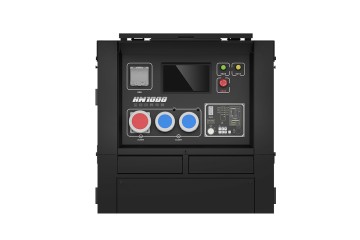
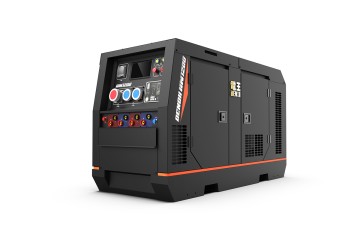
Units like the HW1200 integrate four distinct, fully independent welding arcs within a single diesel engine-generator chassis. In space-constrained offshore work barges or muddy river crossings in Gabon, one machine powers four welders simultaneously, slashing diesel fuel consumption and mobilization logistics by 60%.
Equatorial humidity and fine mineral dust cause premature electrical degradation. Advanced industrial welders are built with IP23/IP54 ingress protection, triple-coated anti-fungal PCBs, vacuum-pressure impregnated transformer windings, and heavy gauge electrostatic powder-coated steel enclosures.
Critical technical and logistical variables every EPC contractor, mine superintendent, and shipyard purchasing manager must verify.
Procuring welding machinery for projects in Gabon requires examining technical factors far beyond simple output amperage ratings. International contractors working on offshore concessions or national infrastructure projects must establish robust partnerships with original equipment manufacturers capable of delivering compliance, modular spares, and sustained technical support. The following four pillars represent the core checklist for industrial buyers:
Furthermore, with international oil majors enforcing stringent welding procedures according to ASME Section IX, API 1104, and AWS D1.1 specifications, machines must maintain precise volt-ampere characteristic curves. Inverter-based engine welders eliminate the voltage fluctuations typical of older brush-type generators, guaranteeing that welding inspectors encounter zero arc-induced porosity or cold lap defects in high-pressure hydrocarbon tie-ins.
Select from our field-proven fleet of heavy-duty, engine-driven pipeline and industrial multi-operator welding systems ready for dispatch.
Key insights concerning import compliance, equipment durability, and maintenance support for heavy industrial welders in Central Africa.