

Leave Your Message
Precision mechanized root-pass and external orbital welding solutions engineered for zero-defect compliance in high-elevation, off-grid pipeline construction.
When pipeline rights-of-way traverse mountain ridges exceeding 3,000 meters above sea level without access to roads or electrical grids, conventional pipeline welding methodologies collapse. Discover how intelligent MIG and TIG automation resolves severe field limitations.
Steep gradients up to 45 degrees make fuel trucks and umbilical cables hazardous. Modern automated tracks feature positive-locking pinion drives and anti-slip track clamps that maintain 0.1mm carriage tracking fidelity across complex slope joint configurations.
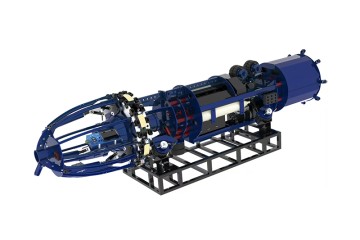
Overcoming internal line-up diesel power losses due to thin mountain air, self-contained lithium battery internal crawlers (DW-EH series) deliver up to 80 joint cycles per charge, operating completely unencumbered by toxic internal exhaust or fragile power cables.
High-yield pipe steels (API 5L X70, X80, and clad alloys) require narrow thermal windows to avoid martensite formation and hydrogen-induced cold cracking. Pulsed Gas Tungsten and Gas Metal Arc Welding dynamically regulate heat input to maintain toughness at -40°C.
Across the globe, the geographical frontier of energy logistics is shifting rapidly into previously inaccessible corridors. From the precipitous slopes of the Andes and the Rocky Mountains to the remote arid ridges of Central Asia and the sub-zero plateaus of the Himalayas, oil, gas, hydrogen, and critical mining slurry pipelines are being routed through severe topographical extremes. In these remote off-grid sectors, traditional spread-welding approaches—relying on fleets of heavy combustion engine generators, manual shielded metal arc welding (SMAW) with cellulosic rods, and labor-heavy squads—are no longer commercially viable or technically acceptable.
The core dilemma of remote mountainous construction resides in the convergence of three harsh constraints: severe logistical isolation, hostile atmospheric thermodynamics, and rigorous metallurgical demands. At elevations above 2,500 meters, atmospheric pressure drops significantly, directly destabilizing shielding gas density and altering the arc ionization potential. Simultaneously, transporting diesel to power multi-kilowatt generator banks across slopes exceeding 30 to 45 degrees poses monumental safety risks and ballooning transport overheads. When weld failure occurs in these inaccessible environments, the cost of cutting out a single defective joint can exceed tens of thousands of dollars, taking into account specialized excavation machinery, crane placement on steep inclines, and right-of-way stabilization.
Consequently, international pipeline operators and EPC contractors have transitioned decisively toward mechanized Gas Tungsten Arc Welding (TIG/GTAW) and Gas Metal Arc Welding (MIG/GMAW, including Pulsed and Surface Tension Transfer variations). When paired with fully automated internal root crawlers and intelligent external orbital bugs, mechanized TIG and MIG systems unlock unprecedented non-destructive testing (NDT) acceptance rates, drastically compress cycle times, and liberate field engineering teams from generator dependency.
Selecting between MIG, TIG, or an optimized hybrid sequence requires an exhaustive evaluation of joint chemistry, groove geometry, ambient conditions, and power availability. Both processes fulfill distinct mechanical functions across the root, hot, fill, and cap passes on high-strength line pipes like API 5L X65, X70, and X80.
Mechanized TIG represents the undisputed standard for metallurgical cleanliness and aesthetic root formation. Using a non-consumable tungsten electrode surrounded by an inert argon or argon-helium gas shield, TIG operates with an exceptionally stable arc column that produces virtually zero spatter. In mountainous transmission projects conveying corrosive sour gas, high-pressure hydrogen blends, or cryogenic natural gas, TIG is routinely deployed for:
However, pure TIG exhibits relatively modest deposition rates (typically 0.8 to 1.5 kg/h). In steep-slope pipeline projects where construction seasons are cut short by winter freezes, relying exclusively on TIG for the full pipe wall thickness is economically prohibitive.
Mechanized MIG/MAG welding counters TIG's deposition limitations by continuously feeding a solid or metal-cored wire through an active or inert shielding gas envelope. With modern inverter controls and digital waveforms, pulsed MIG and modified short-arc MIG (such as STT or RMD) achieve deposition rates between 3.5 and 6.0 kg/h, radically shortening cycle times for heavy-wall line pipes.
| Process Parameter | Mechanized TIG (GTAW) | Mechanized Pulsed MIG (GMAW-P) | Mechanized Hybrid (TIG Root + MIG Fill/Cap) |
|---|---|---|---|
| Primary Application | Critical Root Pass, CRA Clad Pipes, Tie-ins | High-Speed Fill, Hot Pass, and Cosmetic Cap | End-to-End High Productivity Long-Distance Spreads |
| Deposition Rate | 0.8 - 1.6 kg/h (Moderate) | 3.5 - 6.2 kg/h (Very High) | Optimal Combination (Up to 5.5 kg/h Average) |
| Sensitivity to Alpine Wind | High (Demands 100% wind shelters) | Moderate (Resistant with optimized gas shrouds) | Controlled via enclosed crawler + external cab |
| Diffusible Hydrogen | Extremely Low (< 2 ml/100g) | Low (< 4 ml/100g with quality wire) | Ultra-Safe threshold for high-strength steel |
| Power Demand | High arc stabilization need | Inverter-driven, highly efficient power curve | Fully battery-adaptable internal + inverter external |
A critical, often overlooked variable in high-altitude pipeline fabrication (elevations exceeding 2,500m to 4,500m) is the reduction in barometric pressure. Standard flowmeters calibrated at sea level deliver inaccurate volumetric measurements in thin mountain atmospheres. A lower ambient pressure reduces the Reynolds number of shielding gas streams, causing premature turbulence and aspirating ambient air (oxygen and nitrogen) into the arc column. This can cause catastrophic internal porosity and severe titanium/niobium oxidation in microalloyed steels.
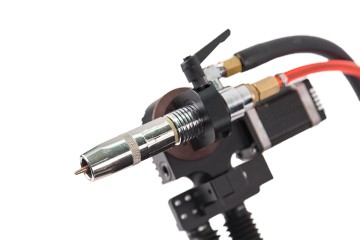
To overcome this, cutting-edge automated external bugs (such as the DW-EW-I series) utilize specialized dual-chamber laminar flow diffusers and closed-loop electronic gas mass flow meters. By monitoring absolute pressure and temperature, the system dynamically modulates flow rates to preserve an uninterrupted laminar shielding envelope even when ridge winds gust outside the habitat.
On steep slopes (slopes of 20° to 45°), conventional internal line-up clamps and internal welding crawlers rely on lengthy pneumatic umbilicals, high-voltage copper tether lines, or trailing diesel air compressors. Umbilical cables draped down a rocky slope present serious safety hazards, including snagging on rock outcrops, damaging external pipe coatings, and dropping voltage over hundreds of meters.
The integration of autonomous, battery-driven internal flexible welders—exemplified by DENOH's DW-EH Series—represents a technological breakthrough for off-grid operations. Featuring built-in industrial lithium iron phosphate (LiFePO4) power cells and an intelligent self-charging motor drive, the crawler traverses the interior of the pipeline independently. It provides rapid internal line-up clamping, counteracts pipe out-of-roundness via radial hydraulic actuators, and completes the entire 360-degree internal root bead autonomously in under 90 seconds. Without external tether cables, job site safety is maximized, and spread logistics are drastically streamlined.
Alpine pipeline construction frequently experiences extreme sub-zero ambient temperatures alongside dramatic day-to-night temperature swings (-20°C to +15°C). Under these conditions, the cooling rate (t8/5 cooling time) of the heat-affected zone (HAZ) accelerates drastically. Rapid cooling transforms the parent metal's austenite into brittle hard martensite, heightening susceptibility to hydrogen-induced cold cracking under pipeline residual stresses.
Mechanized orbital MIG solutions utilize digitally recorded induction preheating combined with pulsed wave parameter locks. The digital power source monitors interpass temperatures in real time, automatically preventing the welding bug from striking an arc until the root or hot pass zone satisfies the pre-set welding procedure specification (WPS). Real-time data logging ensures 100% metallurgical traceability across every single weld bead along the mountain right-of-way.
DENOH Seimitsu Electric Appliance (Beijing) Co., Ltd. is a professional high-tech enterprise integrating independent R&D, sophisticated manufacturing, global sales and full-process professional services of high-end pipeline welding equipment.
With more than 20 years of deep cultivation and continuous innovation in the pipeline welding industry, we have forged a solid industry foundation and built an unshakable market position through decades of practical experience and technological breakthroughs.
Over the past 20-plus years, we have kept pace with the development of the global pipeline engineering industry, constantly optimizing technical solutions and upgrading product systems, witnessing and promoting the iterative upgrading of pipeline welding equipment technology.
The core strength of the company lies in its professional and elite team composed of senior industry experts, professional R&D engineers, skilled technical workers and efficient service personnel. Our R&D team gathers backbones with decades of experience in pipeline welding equipment research and development, many of whom have participated in the research and development of key national engineering supporting welding equipment and possess profound theoretical knowledge and rich practical experience.
Relying on the team's professional strength, we have been committed to tackling key technical problems in the pipeline welding field, breaking through foreign technical monopolies in many core technologies, and realizing the independent innovation and localization of high-end pipeline welding equipment. Meanwhile, our production, sales and service teams have been carefully trained and selected, with rich industry experience and strong professional capabilities, forming a collaborative and efficient working system from R&D and production to market sales and after-sales service.
As mountainous and remote pipeline construction expands across environmentally sensitive territories, the industry is witnessing rapid technological convergence toward automated, data-driven systems. Key emerging trends transforming off-grid welding operations include:
On steep rocky grades, manual torch adjustments can lead to operational inconsistencies. Next-generation orbital heads incorporate compact laser profilometers that scan the open bevel milliseconds ahead of the welding arc. The internal AI processor continuously calculates seam depth, width, and root gap variations, automatically adjusting torch oscillation, travel speed, and wire feed rate in real time to ensure uniform fusion.
Remote off-grid pipeline spreads operate far beyond terrestrial cellular networks. Cutting-edge external welding systems are equipped with low-power satellite telemetry modules (e.g., LEO satellite arrays). Every completed weld joint's voltage curve, current signature, travel velocity, interpass temperature, and GPS coordinates are synced to cloud databases within minutes. Engineering directors in central headquarters can review metallurgical compliance and authorize downstream coating squads with minimal delay.
To reduce carbon footprints and eliminate heavy diesel generator transport across alpine habitats, future remote spreads are adopting hybrid power skids. Combining lightweight hydrogen fuel cells with ultra-high-rate supercapacitors provides the high-amperage surges required during arc starts without degrading storage cells or generating localized emissions in pristine natural ecosystems.
Complete internal battery-driven root welders and precision all-position external bugs tailored for rugged cross-country pipeline infrastructure.