Leave Your Message
Proven equipment deployed in high-pressure cross-country natural gas, crude oil, deepwater tie-backs, and hydrogen blending line construction projects.
Modern energy corridors necessitate unprecedented structural integrity under extreme operating pressures, cryogenic environments, and sour hydrocarbon conveyance.
The global infrastructure for long-distance oil, refined products, natural gas, carbon capture and storage (CCS), and emerging green hydrogen transmission is witnessing a profound technological revolution. As operating pressures escalate beyond 12 to 15 MPa to maximize volumetric throughput over thousands of kilometers, the pipeline construction industry has definitively pivoted away from conventional low-grade steels toward large-diameter (OD 40" to 56" and above) thermo-mechanically controlled processed (TMCP) high-grade microalloyed steels, specifically API 5L X70, X80, and X100.
This metallurgical transition introduces stringent challenges for girth weld fabrication. High-strength pipe steels possess unique chemistries featuring extremely low carbon equivalents, micro-additions of niobium, vanadium, and titanium, and delicate acicular ferrite microstructures. Traditional shielded metal arc welding (SMAW) or manual processes can no longer satisfy the twin demands of ultra-low hydrogen levels (H5 threshold) to prevent cold cracking and the aggressive production cycle times required by international EPC contractors facing daily marine lay barge or onshore spread costs exceeding hundreds of thousands of dollars.
Automated Gas Metal Arc Welding (GMAW/MIG) delivers continuous wire feeding and pulsed arc control, multiplying filler metal deposition rates by up to 300% compared to traditional stick welding while maintaining strict heat-input limits.
Gas Tungsten Arc Welding (GTAW/TIG) guarantees non-porous, zero-spatter, structurally flawless keyhole and root beads, preventing internal turbulence and fatigue nucleation in cyclic and sour-service fluid transit.
Intelligent waveform modulation, micro-processor synergic control, and high-frequency real-time arc sensing compensate dynamically for joint bevel dimensional tolerances and pipe ovality in challenging terrains.
Balancing thermal input, Heat-Affected Zone (HAZ) softening, toughness, and non-destructive examination (NDE) compliance.
Pulsed Gas Metal Arc Welding operates through controlled droplet detachment, transferring one molten drop per electrical current pulse. This eliminates globular spatter, reduces gross heat input into the parent TMCP steel, and prevents grain coarsening within the Coarse-Grained Heat-Affected Zone (CGHAZ). In narrow-gap pipe preparations (with included angles as narrow as 1° to 5°), automated multi-torch tandem MIG configurations deposit fill and cap passes at speeds exceeding 40 to 60 cm/min per buggy, ensuring peak project tempo.
Gas Tungsten Arc Welding provides unmatched concentrated thermal density with complete separation of the heat source and wire feeding. In critical tie-ins, valve stations, Golden Welds (where hydrostatic testing is unfeasible), and high-alloy clad backing runs (Inconel 625 / 825), automated orbital TIG delivers flawless fusion without slag entrapment. The introduction of modern Hot-Wire TIG systems pre-heats the filler wire through resistance heating, increasing TIG deposition rates to approach traditional MIG levels without sacrificing metallurgical purity.
For walls exceeding 22 mm up to 38 mm in X80 and X100 submarine lines, standard V-bevels require excessive volume and thermal cycles, causing cumulative residual stress and weld shrinkage distortion. Automated narrow-gap J-prep designs reduce weld volume by up to 65%.
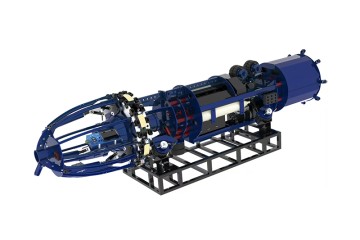
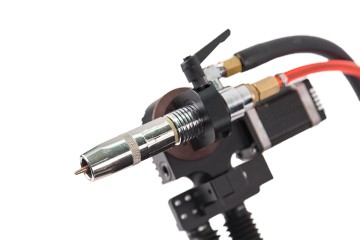
By pairing internal automated multi-head GMAW root welders (such as the DW-EH series) with external narrow-gap dual-torch orbital tractors (DW-EW-I series), contractors achieve complete root-to-cap cycle times of under 8 minutes on 48" X80 pipelines, surpassing standard API 1104 and DNV-ST-F101 qualification benchmarks with zero defect repair rates.
| Welding Process | Typical Pipeline Station | Deposition Rate | Hydrogen Content (ml/100g) | Charpy V-Notch Toughness (-20°C to -40°C) | Key Engineering Benefit |
|---|---|---|---|---|---|
| Internal Multi-Torch GMAW | Internal Root Pass (Station 1) | Very High (4–6 torches concurrent) | < 3.0 (Ultra-low) | > 80 J Average | Eliminates internal copper backing; 100% root penetration within 90 seconds. |
| External Pulsed MIG (GMAW-P) | Hot Pass, Fill & Cap (Station 2-4) | 3.5 – 6.0 kg/hr per head | < 4.0 | > 90 J Average | Exceptional side-wall fusion in narrow bevels; low thermal distortion in X80/X100. |
| Orbital Hot-Wire TIG (GTAW-HW) | Root / Hot Pass in Clad & Sour Lines | 2.0 – 3.8 kg/hr | < 1.5 (Negligible) | > 140 J Superior | Zero spatter, zero pore formation, maximum CTOD (Crack Tip Opening Displacement) values. |
| Mechanized FCAW-G | External Heavy Fill in Extreme Climates | 4.0 – 7.5 kg/hr | < 5.0 (H5 compliant) | > 65 J Standard | Robust tolerance to ambient cross-drafts in exposed right-of-way environments. |
From ultra-deepwater S-Lay barges to Arctic permafrost and 100% pure hydrogen transmission corridors.
Offshore marine pipelay demands flaw-free girth welds capable of withstanding dynamic cyclic fatigue from ocean currents, vortex-induced vibrations, and extreme bending moments during installation. Automated narrow-gap pulsed MIG solutions ensure stringent CTOD toughness exceeding 0.25 mm at 0°C, meeting the highest DNV-OS-F101 submarine pipeline standards.
Sub-zero installations across Siberia, Northern Canada, and high-altitude alpine regions subject X80 pipelines to differential ground settlement and frost heaving. Strain-based design (SBD) requires high overmatching weld metals where orbital MIG and TIG processes maintain low-temperature impact toughness down to -40°C and even -60°C without brittle fracture initiation.
Transportation of wet natural gas containing H2S requires compliance with NACE MR0175 / ISO 15156 to prevent sulfide stress corrosion cracking (SSCC) and hydrogen-induced cracking (HIC). Automated TIG root and narrow-gap MIG cap passes strictly govern hardness below 248 HV10 across the entire fusion boundary and heat-affected zone.
DENOH Seimitsu Electric Appliance (Beijing) Co., Ltd. is a professional high-tech enterprise integrating independent R&D, sophisticated manufacturing, global sales and full-process professional services of high-end pipeline welding equipment.
With more than 20 years of deep cultivation and continuous innovation in the pipeline welding industry, we have forged a solid industry foundation and built an unshakable market position through decades of practical experience and technological breakthroughs. Over the past 20-plus years, we have kept pace with the development of the global pipeline engineering industry, constantly optimizing technical solutions and upgrading product systems, witnessing and promoting the iterative upgrading of pipeline welding equipment technology.
The core strength of the company lies in its professional and elite team composed of senior industry experts, professional R&D engineers, skilled technical workers and efficient service personnel. Our R&D team gathers backbones with decades of experience in pipeline welding equipment research and development, many of whom have participated in the research and development of key national engineering supporting welding equipment and possess profound theoretical knowledge and rich practical experience.
Relying on the team's professional strength, we have been committed to tackling key technical problems in the pipeline welding field, breaking through foreign technical monopolies in many core technologies, and realizing the independent innovation and localization of high-end pipeline welding equipment. Meanwhile, our production, sales and service teams have been carefully trained and selected, with rich industry experience and strong professional capabilities, forming a collaborative and efficient working system from R&D and production to market sales and after-sales service.
How artificial intelligence, laser seam tracking, and automated ultrasonic data correlation are revolutionizing zero-defect girth joining.
The future of large-diameter high-grade pipeline joining is centered on total automation, artificial intelligence, and end-to-end data traceability. Emerging trends actively reshaping the global pipeline welding sector include:
1. 3D Laser Seam Tracking & Adaptive Arc Modulation: By mounting high-speed vision sensors in front of the MIG torch, onboard AI microprocessors scan the exact bevel volume in real time. If joint fit-up varies due to pipe out-of-roundness or hi-lo misalignment, the system dynamically adjusts wire feed rate, torch oscillation width, travel speed, and voltage to maintain exact fill levels and side-wall tie-in without human intervention.
2. IoT Telemetry & Industry 4.0 Digital Records: Modern construction spreads equip every welding power source and orbital crawler with industrial IoT telemetry. Every millisecond of current, voltage, gas flow, interpass temperature, and wire feed speed is logged to an immutable cloud database, linking automatically to Phased Array Ultrasonic Testing (PAUT) records for 100% digital pipeline twin traceability.
Modern internal welders, such as the DW-EH Series, integrate high-density lithium-iron-phosphate battery packs. This removes bulky umbilical trailing cables over kilometers of pipe, increases internal movement speeds between joints by 40%, and mitigates electrical hazards inside confined pipeline spaces.
Advancements in ternary shielding gas mixtures (Ar + CO2 + He + trace O2 or H2) enable narrower arc columns, deeper penetration profiles in heavy walls, and ultra-smooth bead wetting transitions, significantly lowering stress concentration factors at the weld toe.
Select from our field-proven portfolio of internal root machines, orbital external tractors, and intelligent pipeline welding gear.