
Leave Your Message
Engine-driven high-performance power sources optimized for autonomous field welding and pipeline construction.
Heavy-duty construction projects, particularly those involving pipeline laying, structural steel erection, and offshore installations, demand an unprecedented level of operational efficiency and structural integrity. Historically, field welding was a highly labor-intensive process, reliant on manual operators working under demanding environmental conditions. Today, the industrial landscape is undergoing a massive shift towards autonomous field welding. Autonomous welding systems—incorporating orbital welding heads, computerized control systems, and robotic crawlers—require a highly stable, uninterrupted power source to function correctly. This is where the specialized Field Use Welder Generator becomes the cornerstone of modern heavy-duty construction sites. These advanced, engine-driven systems do not simply supply welding current; they act as mobile power grids, delivering clean electricity to both the welding arc and the sophisticated digital controllers that govern autonomous welding operations.
With the integration of robotic automation in field welding, the stability of the power source is no longer just about weld appearance—it is critical to the survival of the control hardware and the consistency of automated welding parameters.
Global infrastructure development is expanding rapidly, with thousands of miles of oil, gas, water, and slurry pipelines being laid annually across remote terrains. At the same time, structural steel projects for transport hubs, high-rise buildings, and industrial plants are scaling up. The commercial pressure on these projects is immense. Delays can result in liquidated damages running into hundreds of thousands of dollars per day. To mitigate this risk, developers are increasingly adopting automated and semi-automated welding systems. These systems promise consistent, high-quality welds at speeds that manual welding crews cannot match.
However, the transition to autonomous field welding introduces new technical challenges. Manual welding is relatively forgiving of minor fluctuations in welding current. In contrast, autonomous welding systems rely on precise digital parameters—wire feed speed, travel speed, oscillation, and voltage must be maintained within extremely narrow tolerances. Any fluctuation in power can lead to weld defects, such as lack of fusion, porosity, or burn-through, which are costly to repair and can compromise the integrity of the entire structure.
Consequently, the market demand for high-performance, engine-driven welder generators has surged. Modern construction companies view these machines as critical assets. They must provide dual functionality: delivering high-amperage welding current (often for multiple operators or arcs simultaneously) and generating stable auxiliary AC power to run control computers, induction heating equipment, wire feeders, and field lighting. The integration of these systems reduces the footprint of equipment on-site, simplifies logistics, and lowers overall fuel consumption, making them highly attractive from both an operational and financial perspective.
Stable voltage control is vital for automated welding bugs. Voltage spikes or sags can cause processing units to crash, halting the welding process mid-pass.
The field of autonomous welding is evolving rapidly, driven by advancements in sensor technology, artificial intelligence, and power electronics. One of the most significant trends is the integration of real-time monitoring and adaptive control systems. Modern autonomous welding bugs are equipped with laser tracking sensors and high-speed cameras that monitor the weld joint ahead of the arc. This data is processed instantly, and the system adjusts the welding parameters—such as current, voltage, and travel speed—on the fly to compensate for variations in joint fit-up.
To support these advanced systems, welder generators are also becoming smarter. The latest generation of field welder generators features digital communication interfaces (such as CAN bus) that allow the generator to communicate directly with the welding robot. This integration enables the welding system to dynamically manage the engine speed and generator output, optimizing fuel efficiency and reducing emissions. For example, during non-welding intervals, the engine can drop to a low idle, saving fuel, and then instantly ramp up to full power the moment the arc is struck.
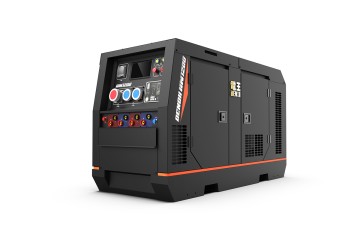
Another key trend is the shift towards multi-arc and multi-process configurations. In pipeline welding, for instance, it is common to use dual-torch or even four-torch orbital welding systems to complete welds faster. A single welder generator, such as the HW1200, must be capable of powering these multiple arcs independently, without any electrical interference between them. This requires advanced alternator design and sophisticated electronic control modules to ensure that a voltage drop on one arc does not affect the stability of the other arcs.
1. Cross-Country Oil and Gas Pipeline Erection: Pipeline construction is perhaps the most demanding application for autonomous field welding. Pipelines often traverse incredibly harsh environments, from the freezing tundras of Siberia and northern Canada to the scorching deserts of the Middle East. In these remote locations, access to the utility grid is non-existent. Welder generators must operate reliably in temperatures ranging from -40°C to +50°C and at high altitudes where the air is thin. The autonomous welding process involves internal pneumatic line-up clamps with built-in copper backing shoes, followed by external orbital welding bugs that complete the hot, fill, and cap passes. The welder generator must provide steady power to the internal welders, the external bugs, the induction heating coils used for pre-heating the pipe, and the compressor that operates the pneumatic clamps. Any power failure can stall the entire pipeline spread, costing tens of thousands of dollars per hour.
2. Structural Steel Construction for Mega-Infrastructure: Large-scale civil infrastructure projects, such as suspension bridges, high-speed rail networks, and mega-airports, require massive amounts of structural steel welding. On these sites, safety and structural integrity are paramount, and welds are subject to rigorous non-destructive testing (NDT), including ultrasonic and radiographic inspection. Autonomous welding robots are increasingly used to weld thick structural steel plates, often in vertical or overhead positions. These robots require a consistent power source that can maintain a stable arc even when using long welding cables. In high-rise construction, the welder generator is typically located at ground level, while the welding robot operates hundreds of feet in the air. The generator must have the capacity to overcome the voltage drop associated with long cable runs, ensuring that the robot receives the precise voltage required to produce defect-free welds.
3. Offshore Wind Farm Foundation Fabrication: The transition to renewable energy has driven a massive expansion in offshore wind farms. Fabricating the monopiles and jacket structures that support these massive wind turbines requires welding extremely thick steel sections, often exceeding 100mm in thickness. While much of this fabrication is done in yards, final assembly and tie-ins often occur in coastal or offshore environments. Here, the welder generator must withstand highly corrosive salt air, high humidity, and constant vibration. Autonomous submerged arc welding (SAW) and flux-cored arc welding (FCAW) systems are used to complete these heavy-duty welds. The welder generator must be housed in a rugged, corrosion-resistant enclosure and equipped with heavy-duty filtration systems to prevent salt and moisture from damaging the internal electronics.
Constant speed engine-driven welding machines provide the rotational inertia needed to absorb sudden load spikes when the arc strikes, preventing voltage dips that disrupt digital controllers.
To fully appreciate the role of welder generators in autonomous field welding, it is necessary to understand their technical architecture. The core of these machines is the engine-alternator combination. Diesel engines are preferred for heavy-duty applications due to their durability, high torque at low RPMs, and fuel safety on construction sites. The alternator converts the mechanical energy of the engine into electrical energy.
In modern multi-function welder generators, the alternator is designed to produce both high-current DC welding power and stable AC auxiliary power. This is achieved through the use of separate windings or advanced electronic control systems. For autonomous welding, the stability of the auxiliary power is just as important as the welding power. The digital controllers, sensors, and drive motors of the welding robots are sensitive to voltage fluctuations, spikes, and electromagnetic interference (EMI). High-quality welder generators utilize electronic voltage regulators (AVR) and inverter technology to deliver clean, stable AC power with minimal harmonic distortion.
Additionally, the welding output itself must be highly controllable. Traditional machines used manual dials to set the current, which could drift as the machine warmed up. Modern units use digital signal processors (DSPs) to monitor the arc thousands of times per second, adjusting the output instantly to maintain a stable arc length and prevent spatter. This level of control is essential for autonomous welding, where the robot cannot "feel" the arc and adjust its hand like a human welder; it relies entirely on the machine to maintain a stable, consistent arc.
Ensuring operational reliability from research and design to on-site implementation.
With more than 20 years of industry accumulation, we have accumulated profound technical expertise and strictly adhere to high-standard production norms.
We have built a comprehensive and rigorous whole-process quality control system to ensure the excellent performance and stable quality of every product.
Covering pre-sales consultation, on-site guidance and after-sales support, we form a well-laid, efficient and reliable global product supply network.
Advanced equipment tailored for challenging pipeline and infrastructure projects.
Equipped with independently developed core patented technologies, these products feature outstanding advantages such as high efficiency, energy saving, precise welding, stable operation, durability and strong adaptability to harsh field and complex engineering conditions. We hold multiple independent intellectual property patents and have obtained a number of national and international authoritative industry certifications, which fully affirm our technical strength and product quality.
Relying on reliable product strength, professional and efficient full-process services, as well as the team's dedicated craftsmanship and 20 years of brand reputation, we have established long-term stable cooperation with leading enterprises in domestic oil and gas long-distance pipelines, municipal engineering, new energy infrastructure and other key fields.
Adhering to technological innovation as the core driving force and ingenuity quality as the foundation, we are committed to providing global customers with customized one-stop pipeline welding solutions, and continuously contributing to the high-quality and sustainable development of energy infrastructure projects at home and abroad.
Let's start your project together →Explore our complete range of diesel-driven welding systems engineered for autonomous field operations and heavy-duty construction sites.