Leave Your Message
Modern global energy transit relies heavily on long-distance, high-pressure pipelines. As the demand for natural gas, crude oil, and hydrogen fuel networks increases, the infrastructure must adapt. Today's pipelines feature larger diameters—frequently exceeding 40 inches (1016 mm) and scaling up to 56 inches (1422 mm)—and utilize high-grade steels such as API 5L X70, X80, and X100. These high-yield strength materials allow for higher operating pressures and thinner wall designs, substantially reducing overall project steel weight and transport costs.
However, welding these massive, thick-walled, high-grade steel conduits presents formidable engineering challenges. The mechanical integrity of the girth weld is the single most critical factor in pipeline safety. In these high-stakes environments, the "4 People Welding" method (or simultaneous four-operator welding) has emerged as a gold standard in manual and semi-automatic field operations. By utilizing multiple operators working in coordinated quadrants, pipeline contractors achieve the balanced heat distribution and rapid cycle times necessary to prevent structural distortion and metallurgical degradation.
Simultaneous welding by 4 operators minimizes localized thermal stress and prevents cracking in high-grade steels.
Reduces cycle times by up to 60% compared to traditional single-operator or dual-operator setups.
Prevents pipe ovality deformation and ensures uniform bead profile around the entire circumference.
The "4 People Welding" configuration is a highly synchronized operation where four professional welders are positioned around the pipe circumference. Typically, the pipe is divided into four quadrants: top-right, bottom-right, top-left, and bottom-left. Working in pairs, the welders execute their passes symmetrically. For instance, two operators will handle the upper halves (from 12 o'clock to 3 o'clock and 9 o'clock positions), while the other two complete the lower halves down to the 6 o'clock position.
This layout is not merely about speed; it is about controlling the physics of steel cooling. When welding high-grade steels like X80, rapid cooling rates can lead to the formation of brittle martensite phases, making the joint susceptible to Hydrogen-Induced Cracking (HIC). Symmetrical, simultaneous welding by four operators maintains a steady, controlled interpass temperature. This thermal equilibrium acts as a natural post-weld heat treatment, tempering the heat-affected zone (HAZ) and preserving the steel’s native toughness and ductility.
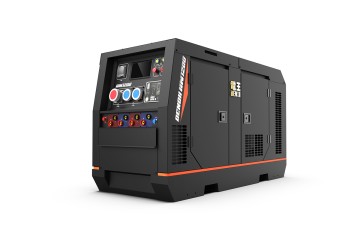
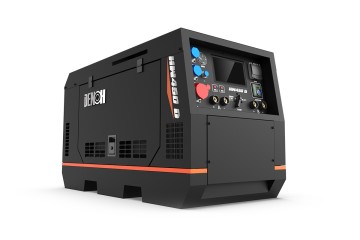
To support this intense, multi-arc demand, field operators require specialized power sources. Standard single-operator welding machines are insufficient. Advanced multi-arc engine-driven generators, such as the HW1200, are designed specifically to feed multiple independent welding arcs from a single diesel-driven unit. This ensures that voltage fluctuations caused by one welder striking an arc do not affect the stability of the other three arcs, maintaining a smooth, spatter-free weld pool across all quadrants.
While manual "4 People Welding" remains indispensable in rugged, inaccessible terrains, the global pipeline industry is rapidly shifting toward a hybrid model that integrates automated equipment. Automated internal welding systems and external welding robots work in tandem with skilled operators to achieve unprecedented deposition rates and defect-free statistics.
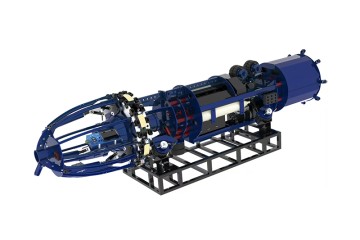
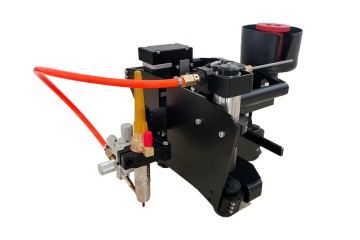
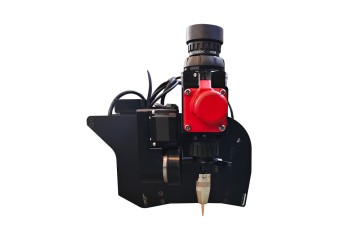
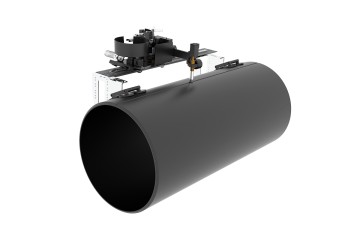
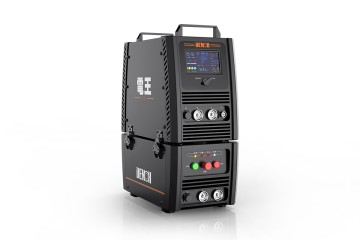
An exemplary workflow involves using a fully automatic battery-powered internal welding machine (such as the DW-EH Series) to perform the critical root pass from inside the pipe. The internal welder quickly aligns the pipe sections using pneumatic or hydraulic clamps and deposits the root bead. Immediately following this, a team of external operators—or single/dual-torch external welding robots (such as the DW-XW-I)—execute the hot, fill, and cap passes from the outside. This combination minimizes the time the pipe clamp must remain in place, drastically speeding up the pipeline's forward progression.
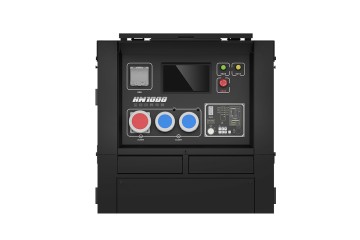
Additionally, modern engine-driven welding machines have evolved from simple generators to smart, multi-functional energy hubs. These systems feature digital control interfaces, preset welding parameters for different steel grades, and dual-operator or four-operator outputs that reduce the footprint of equipment on the right-of-way (ROW). This reduction in machinery not only lowers fuel consumption and logistics costs but also minimizes the environmental footprint of the pipeline construction corridor.
With more than 20 years of industry accumulation, we have accumulated profound technical expertise and strictly adhere to high-standard production norms.
We have built a comprehensive and rigorous whole-process quality control system to ensure the excellent performance and stable quality of every product.
Covering pre-sales consultation, on-site guidance and after-sales support, we form a well-laid, efficient and reliable global product supply network.
Equipped with independently developed core patented technologies, these products feature outstanding advantages such as high efficiency, energy saving, precise welding, stable operation, durability and strong adaptability to harsh field and complex engineering conditions. We hold multiple independent intellectual property patents and have obtained a number of national and international authoritative industry certifications, which fully affirm our technical strength and product quality.
Relying on reliable product strength, professional and efficient full-process services, as well as the team's dedicated craftsmanship and 20 years of brand reputation, we have established long-term stable cooperation with leading enterprises in domestic oil and gas long-distance pipelines, municipal engineering, new energy infrastructure and other key fields.
Adhering to technological innovation as the core driving force and ingenuity quality as the foundation, we are committed to providing global customers with customized one-stop pipeline welding solutions, and continuously contributing to the high-quality and sustainable development of energy infrastructure projects at home and abroad.
Let's start your project together →